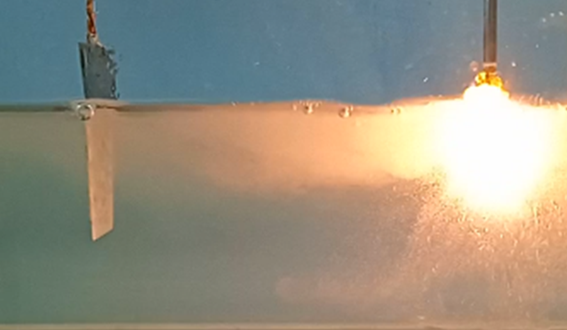
Cathodic Plasma-Driven Solution Electrolysis (CPDSE) is a highly efficient method for hydrogen production and is considered one of the advanced oxidation processes (AOPs), enabling simultaneous treatment of wastewater contaminated with a wide range of organic pollutants, including aromatic compounds, dyes, solvents, surfactants, pesticides, and pathogenic microorganisms. Hydrogen production via CPDSE exhibits significantly higher Faradaic efficiency, often surpassing conventional water electrolysis, depending on the organic pollutant concentration. Recent integration of ultrasonication with CPDSE has demonstrated a double synergistic effect, reducing overall energy consumption by nearly 50%. This combined CPDSE-ultrasound (US) process, called as CombiSonoPlasma® (CSP), has been successfully tested for the degradation of oil in hypersaline produced water originated from the oil extraction industry, achieving over 80% reduction in total organic carbon (TOC).
In collaboration with researchers from Poland, Italy, Hungary, and Denmark, the CSP-based eco-innovation is proposed for the treatment of tannery and textile wastewater. The primary aim of the project is to advance the CSP process as an AOP for textile and tannery wastewater treatment, focusing on organic pollutant degradation, hydrogen production, desalination, and the recovery of critical raw materials (CRMs) such as Ni, Mg, Mn, B, Cu, and Sb. Concurrently, the process aims to reduce heavy metal concentrations, including Cr and Cd. The research will investigate the relationship between process parameters, hydrogen production efficiency, and the effectiveness of wastewater treatment, while leveraging the CSP process for desalination and CRM recovery. The project will culminate in an upscaled CSP reactor capable of processing 300 L/h of real textile and tannery wastewater, achieving simultaneous hydrogen production, desalination, and CRM recovery effect. Feasibility of the upscaled wastewater treatment system will be validated by LCA and techno-economic analysis.
The proposed project aligns with topics 1.2 and 3.1 of the WATER4ALL call, focusing on developing innovative processes for wastewater treatment and reuse, as well as integrated approaches for recovering valuable resources (CRMs) and energy from wastewater. This innovative approach to wastewater treatment, hydrogen production, desalination and material recovery is expected to support the energy transition, circular economy principles, and wastewater reuse strategies.
Keywords: organic pollutants, plasma electrolysis, sonication, hydrogen production, recovery of critical raw materials, desalination, wastewater valorization
Project coordinator:
Research and Innovation Centre Pro-Akademia
Project partners:
University of Napels Federico II (Italy)
Bulkai Ltd (Hungary)
Aalborg University (Denmark)
Funding organisations:
Poland – Narodowe Centrum Badań i Rozwoju (NCBR)
Italy – Italian Ministry of Universities and Research (MUR)
Hungary – Nemzeti Kutatási, Fejlesztési és Innovációs Hivatal (NKFIH)
Denmark – Innovation Fund Denmark (IFD)
Duration: 3 years
Contact:
Marcin Siedlecki [email protected]
Sergii Bespalko [email protected]